E-Course Food Systems Finance

This new e-course on Food Systems Finance explains the concepts and practice of food systems and the relevance this has for the public and private financial sector. It will help you to think through how food system challenges and finance are intimately related with each other, and how finance professionals can make a positive contribution to the food system.
The first cohort started this very first edition of the e-course Food Systems Finance on 10 November 2025
The e-course Food System Finance was initiated by the Netherlands Food Partnership and compiled in cooperation with Wageningen University & Research, Fair & Sustainable Consulting and a reference group of public & private finance professionals and supported by the Netherlands Ministry of Foreign Affairs and the Netherlands Ministry of Agriculture, Fisheries, Food Security and Nature.
Food Systems Finance looks fundamentally at how public and private finance influence socio-economic, environmental and food security & nutrition outcomes of the food system. These influences can be both positive and negative. In this course we explore how the public and private financial sector can contribute to shifting undesirable food outcomes towards positive results.
Reversely, food systems can also influence the financial sector. Risks in the food system may affect financial portfolios, through physical risks, reputation risks and transition risks. In the e-course we look into this, and reflect on how finance professionals can assess and mitigate risks in the food system.
Food systems finance is a relatively new topic: it does not have standing practices yet, nor standardized procedures, and it is developing year by year. By participating in this course, you will be part of a frontrunners group, charting new territory and developing new solutions. The e-course is designed for professionals from the public and private financial sector.
The course is built up in four modules. In each module, you will find short blocks, combining theory with practice. Some blocks contain reading materials, others are shaped in the form of short videos or infographics. We kept the compulsory material short and to-the-point, and made suggestions for further reading if you want to go deeper.
Course participants can complete each of the modules at a time of their convenience in the indicated week. In week 1 and week 3 we intend to have an on-line plenary session with all particpants.
Modules | Title | Week | Starting date | Study time |
Module A | Understanding food systems transformation | Week 1 | 10 Nov | 2.5 hours |
Module B | Strategizing finance for food systems | Week 2 | 17 Nov | 2.5 hours |
Pause week | Week 3 | 24 Nov | ||
Module C | Operationalizing finance for food systems | Week 4 | 1 Dec | 2.5 hours |
Module D | Measuring impact on food systems finance | Week 5 | 8 Dec | 2.5 hours |
In the first plenary webinar of the Food Systems Finance e-course, participants explored how financial actors—public, private, and blended—can catalyse food systems transformation. The experts Mrs. Nadine Gbossa, IFAD Director of Food Systems Coordination and Mr. Anil Kumar, Founder & Group CEO of Samunnati, India’s largest agri-enterprise, shared their views, tools, lessons, and real-world examples from global and Indian contexts. Read more and watch the summary recording through the button below.
The 2nd webinar of the Food Systems Finance e-course featured expert speakers from the World Bank Group and the Rabo Foundation. The session provided rich perspectives on redirecting agricultural support and strengthening the financial mechanisms needed to transform food systems. Dr. Sergiy Zorya, Global Lead for Public Policy and Expenditures at the World Bank Group, delivers a compelling call to rethink global agricultural support as he unveils data-driven tools, policy packages, and real-world success stories—insights that invite a deeper look into his transformative vision for sustainable food systems. Mr. Bas Evers, Program Manager Africa at the Rabo Foundation, shares high-impact examples of how targeted financing can transform opportunities for smallholder farmers and MSMEs—and if you’re curious to discover the four critical enabling factors behind this success, be sure to read the article and watch the video. Read more and watch the summary recording through the button below.
Find out more about the characteristics of the 240 professionals trained through this 1st edition of the e-course Food System Finance. Characteristics such as geographical focus, type of organisation they work for, gender and age. Click the button to read more ....
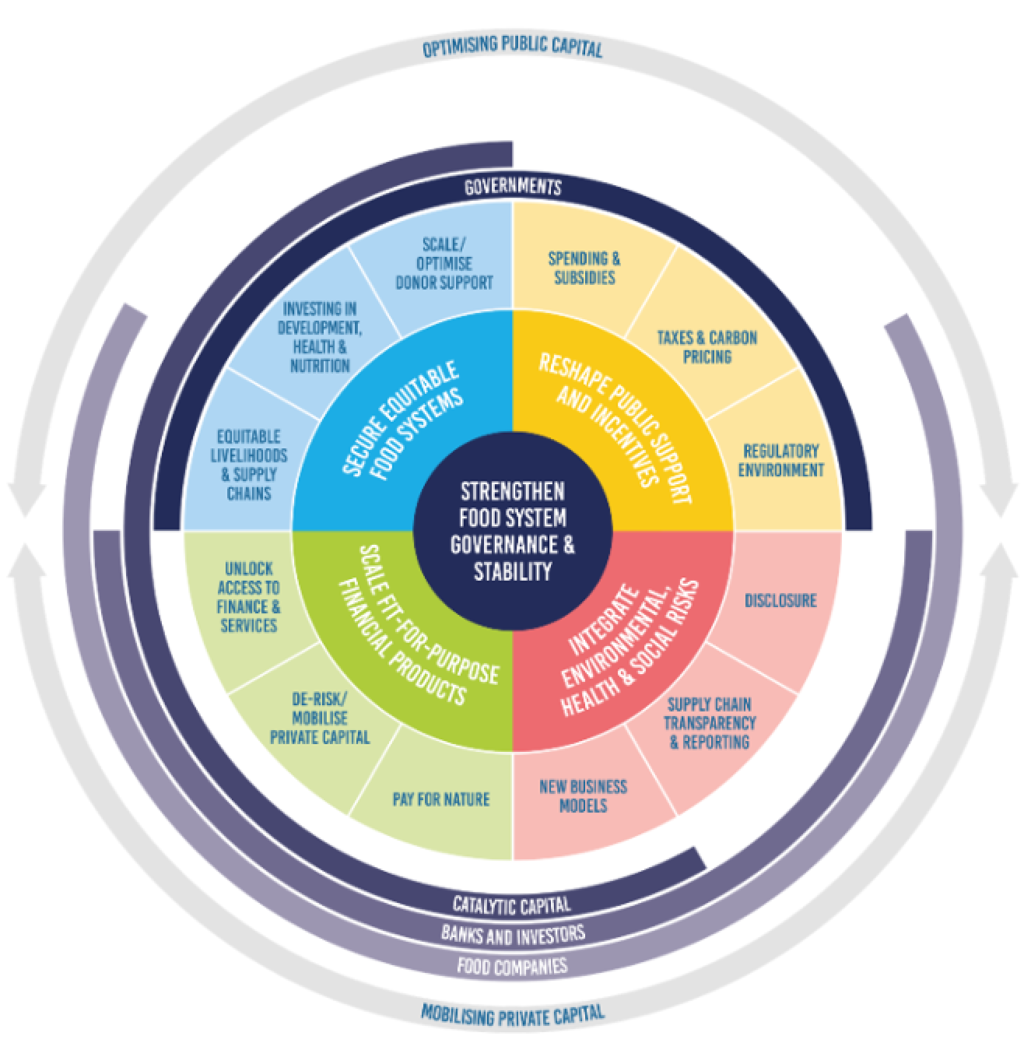
Food Finance Architecture
Source: UNFSS et al (2023), Food finance architecture – financing a healthy, equitable and sustainable food system, UNFSS with World Bank, Food and Land Use Coalition and IFPRI,
Authors

Lisette van Benthum
NFP Coalition Builder